
August 21, 2026
Bubbles, The Average Stock, Gas, Breadth, Leverage
1. Bubble
The higher the market flies, the louder the worries about an AI bubble grow. I get it. But history shows that speculation and innovation are often intertwined, making the story more nuanced than a yes-or-no verdict. As Baird Strategas wrote last year: “When we invent nice things, bubbles happen. Many modern technologies were accompanied by overenthusiastic investment yet were net positives for the global economy (railroads, computers)…the key lies in what the boom produces and how it is financed.” An important lesson from history is that many speculative bubbles coincide with overinvestment that becomes productive infrastructure, even if investors lose money in the process. For example, the dot-com bust left behind a massive network of fiber optic cable and server infrastructure that later facilitated the “Web 2.0” era and the post-2010 bull market in Tech stocks. Not every bubble leaves a positive legacy (see: tulips, real estate), but whatever AI’s future, the investment in data centers, chip technology, power generation, etc. is investment in useful assets (and feverish competition tends to accelerate innovation). Stocks may go down in the meantime, but in the “good vs. bad” bubble debate, I lean to the former.
2. Average
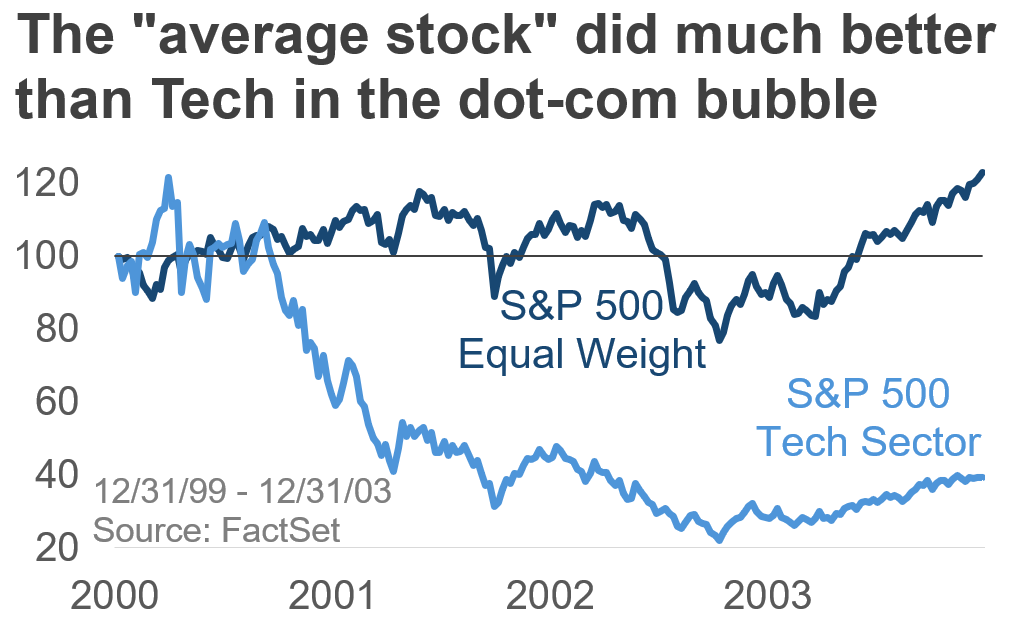
In a “good bubble,” investors can benefit from a capital spending binge even if they don’t participate fully today. We can remain invested without chasing the frothier parts of the market and still benefit from any future economic growth that comes from all this infrastructure spending. From the time the S&P 500 peaked in early 2000 (dot com bubble) to its trough in late 2002, the Tech sector dropped 82%, but the average stock fell just 29% (still painful, but on the scale of a garden variety bear market akin to 1990, 2011, or 2022). (We use the S&P 500 Equal Weight index as a proxy for the "average stock" because each constituent receives the same weight.) The Tech sector did not recover for nearly two decades but the average stock was back at a new all-time high before 2003 even ended. A more diversified investor stood to shed even less across 2000-2002. The price of that protection is accepting that you’re likely to lag the market's hottest corners on the way up. It takes discipline to keep FOMO from dictating your investment decisions.
3. Gas
The U.S., the world’s largest natural gas producer, is on pace for record production in 2026. We’ll need every molecule.
4. Breadth
In our more technical commentary, we talk about breadth. A broader market doesn’t guarantee future gains but it is typically a sign of a healthier economic backdrop. When more stocks participate in a market advance, the market relies less on a small group to keep working. This summer we’ve talked about a broadening U.S. market, with sectors like Financials and Healthcare leading the pack. But the best evidence of this bull market’s strength may come from abroad. The MSCI EAFE, a gauge of developed market stocks that excludes the U.S., has outpaced the S&P 500 over the last year, without a heavy dose of AI. The MSCI EAFE’s largest 10 stocks make up just 14% of its total weight (vs. ~40% for the S&P 500), and Tech represents just 10% of the index. AI might dominate the headlines, but the market's ability to generate returns outside of AI-related companies is noteworthy as well.
5. On this day
in 1998, Long Term Capital Management, an acclaimed hedge fund helmed by Nobel laureates, lost $550 million in a single day (five times more than its models projected was possible). The culprit? Leverage, and loads of it. As we also saw more recently with last month’s Situational Awareness blowup, the use of excessive leverage can swiftly turn a manageable loss into a forced liquidation. In today’s world of leveraged ETFs, perpetual futures, and options that expire at the end of the same trading day, I worry that (unfortunately) this lesson can’t be learned enough times.
Disclosures
This is not a complete analysis of every material fact regarding any company, industry or security. The opinions expressed here reflect our judgment at this date and are subject to change. The information has been obtained from sources we consider to be reliable, but we cannot guarantee the accuracy. Market and economic statistics, unless otherwise cited, are from data provider FactSet.
This report does not provide recipients with information or advice that is sufficient on which to base an investment decision. This report does not take into account the specific investment objectives, financial situation, or need of any particular client and may not be suitable for all types of investors. Recipients should not consider the contents of this report as a single factor in making an investment decision. Additional fundamental and other analyses would be required to make an investment decision about any individual security identified in this report.
For investment advice specific to your situation, or for additional information, please contact your Baird Financial Advisor and/or your tax or legal advisor.
Past performance is not indicative of future results and diversification does not ensure a profit or protect against loss. All investments carry some level of risk, including loss of principal. An investment cannot be made directly in an index.
Copyright 2026 Robert W. Baird & Co. Incorporated.
Other Disclosures
UK disclosure requirements for the purpose of distributing this research into the UK and other countries for which Robert W. Baird Limited holds an ISD passport.
This report is for distribution into the United Kingdom only to persons who fall within Article 19 or Article 49(2) of the Financial Services and Markets Act 2000 (financial promotion) order 2001 being persons who are investment professionals and may not be distributed to private clients. Issued in the United Kingdom by Robert W. Baird Limited, which has an office at Finsbury Circus House, 15 Finsbury Circus, London EC2M 7EB, and is a company authorized and regulated by the Financial Conduct Authority. For the purposes of the Financial Conduct Authority requirements, this investment research report is classified as objective.
Robert W. Baird Limited ("RWBL") is exempt from the requirement to hold an Australian financial services license. RWBL is regulated by the Financial Conduct Authority ("FCA") under UK laws and those laws may differ from Australian laws. This document has been prepared in accordance with FCA requirements and not Australian laws.